News
Significant Reductions in SNAP Benefits Expected, Potentially Leaving Millions Without Aid

The Looming Crisis: Reduced Food Aid Threatens Vulnerable Families
Initial Impact of Food Aid Reductions
Washington is bracing for substantial cutbacks in food stamp benefits for the nation's most economically vulnerable citizens. A recent study indicates that these reductions might be far more drastic than initially predicted, raising the possibility that millions could find themselves without any assistance whatsoever.
Policy Group's Critical Assessment of the Benefit Plan
The Center for Budget and Policy Priorities, a prominent organization focusing on research and policy from a progressive viewpoint, meticulously examined the Trump administration's proposal for partial SNAP benefit disbursements to individual states. Their findings reveal that roughly 40% of households, those currently receiving the maximum food stamp allocation, will experience a halving of their payments.
Disproportionate Impact on Households with Modest Incomes
However, families with some form of income, regardless of its source—be it social security, disability payments, or wages—are projected to bear an even heavier burden of these cuts. The Center's analysis suggests that certain single- or two-person households may receive as little as $12, and an alarming 1.2 million households could see their benefits completely eliminated.
Vast Number of Individuals Left Without Support
Katie Bergh, a food policy analyst affiliated with the Center, expressed grave concerns, stating that an estimated five million individuals will be deprived of any benefits whatsoever. This underscores the profound human impact of the proposed changes.
Underspending of Allocated Funds for Food Assistance
Furthermore, the Center for Budget and Policy Priorities estimates that, under the revised partial spending framework, the U.S. Department of Agriculture (USDA) will only utilize approximately $3 billion from its contingency fund. This amount falls significantly short of the $4.65 billion that two judicial rulings mandated for the continued flow of SNAP entitlements. Bergh criticized this approach, asserting that the administration is "shortchanging families" by not fully deploying available funds due to a benefit reduction strategy.
USDA's Silence on the Analysis
As of the time of reporting, the USDA has not issued any public response to NPR's inquiries regarding the Center's detailed analysis of the benefit cuts.
Procedural Hurdles and Delays in Benefit Distribution
The implementation of the administration's intricate partial funding model presents immense operational challenges for states, which are responsible for managing the program that serves 42 million Americans. Even the USDA acknowledged that distributing these benefits could take several weeks, or even months.
State-Level Difficulties and Obsolete Systems
Tikki Brown, who leads Minnesota's Department of Children, Youth and Families, highlighted the need for a "complete recalculation and a complete recoding" of their systems, indicating that no specific timeline for payments in her state has been established. Danny Mintz, from Code for America, pointed out that some states operate with outdated systems dating back to the 1970s, making rapid adjustments to complex calculation changes exceptionally difficult. He cautioned that altering benefit calculations could potentially "break things" within these systems and emphasized that the swiftest way to deliver aid is for the USDA to fully fund SNAP benefits.
Calls for Simpler Solutions and Legal Interventions
Several states are already issuing warnings about potential delays in payment processing. In a strongly worded communication to the USDA, which was obtained by NPR member station WESA, Pennsylvania Human Services Secretary Val Arkoosh criticized the federal government for directing states to adopt "the most complex and labor-intensive approach possible." Pennsylvania has proposed using a more straightforward method, similar to one employed during pandemic relief efforts, which would uniformly provide half of the SNAP payment to all recipients. The looming delays and missed payments have prompted a coalition of cities and non-profit organizations to return to federal court in Rhode Island, seeking to compel the administration to adhere to the order for an "expeditious" resumption of SNAP aid.
Data journalist and illustrator making statistics accessible for The Guardian and others.
Other Articles
 Nov 06, 2025
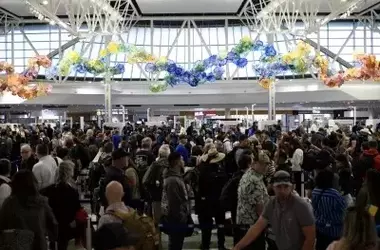
Government Shutdown Looms Over Thanksgiving Travel Plans
As Thanksgiving approaches, a potential government shutdown could significantly impact holiday air travel. With air traffic controllers and TSA agents possibly working without pay, experts warn of increased delays, cancellations, and longer security lines. Travelers are advised to plan carefully, consider flexible tickets, and prioritize early, nonstop flights to mitigate potential disruptions.
By Michele Norris Nov 06, 2025
Government Shutdown Disrupts Telehealth Services for Medicare Beneficiaries
The recent government shutdown has severely impacted Medicare patients' access to telehealth services, a modality that gained significant traction during the pandemic. With temporary payment allowances for virtual appointments no longer being renewed, many elderly and vulnerable patients are left with limited options, facing either in-person visits with long waits or out-of-pocket expenses for remote care. This disruption highlights the fragility of healthcare access amidst political impasses and raises concerns about the long-term stability of telehealth.
By Ann Curry Nov 06, 2025
AI's Growing Energy Appetite: The Unseen Force Behind Rising Electricity Bills
Artificial intelligence is significantly contributing to the surge in electricity demand, pushing up utility costs nationwide. Data centers, essential for AI operations, consume vast amounts of power, impacting residential rates. This trend, combined with factors like natural gas prices and aging infrastructure, creates a complex challenge for consumers and utility providers alike.
By Carl Bernstein