News
Alaska's Journey from Russian Territory to US State

The historical journey of Alaska from a Russian territory to a U.S. state is a fascinating narrative that predates contemporary geopolitical discussions. This transformation, rooted in a pivotal 19th-century transaction, continues to resonate, especially as leaders from the United States and Russia prepare for critical dialogues, reminding us of the enduring legacy of diplomatic and territorial shifts.
Initially a vast and largely unexplored Russian colonial outpost, Alaska became a subject of strategic interest for the United States in the mid-19th century. The 1867 purchase, often dubbed \"Seward's Folly\" after then-Secretary of State William H. Seward, saw the U.S. acquire this immense landmass for a mere $7.2 million. This acquisition, though initially met with skepticism, proved to be a geopolitical masterstroke, significantly expanding American territory and influence in the North Pacific. Despite the passage of time and the territory's full integration into the U.S. as a state, there remains a segment of the Russian populace that harbors a sense of historical grievance or questioning regarding the sale's legitimacy, underscoring the deep-seated historical memory tied to such significant national decisions.
The story of Alaska's transition from Russian ownership to American sovereignty serves as a powerful reminder that history is not merely a collection of past events, but a dynamic force that continues to shape current perceptions and international relations. It emphasizes the importance of understanding historical contexts to navigate complex present-day interactions and to appreciate the intricate tapestry of global diplomacy and national identity. Such historical episodes underscore the value of peaceful transfers and the long-term benefits of visionary leadership that, even if initially misunderstood, can pave the way for greater stability and progress.
Award-winning journalist and former NBC News anchor and Today show co-host.
Other Articles
 Aug 13, 2025
The Quest for Collective Glory: A Look at Mass Participation World Records
This article explores the enduring allure and intricate challenges of achieving mass participation Guinness World Records. From a kazoo ensemble aiming for a new high to the struggles of gathering thousands for unique feats, it delves into the meticulous rules, logistical hurdles, and underlying motivations that drive individuals, organizations, and even cities to pursue official glory in an increasingly digital world.
By Lester Holt Aug 13, 2025
Famine Early Warning System Revived After Trump-Era Freeze
In 1985, the Ethiopian famine spurred the Live Aid concert and the creation of FEWS NET, a U.S. famine early warning system. This vital program, which alerts governments and aid groups to impending food crises, was unexpectedly suspended during the Trump administration. Now, the system is being reactivated, bringing a mix of relief and concern among humanitarian experts regarding its future efficacy and funding. Its return is critical for preventing widespread starvation and humanitarian crises globally.
By Mona Chalabi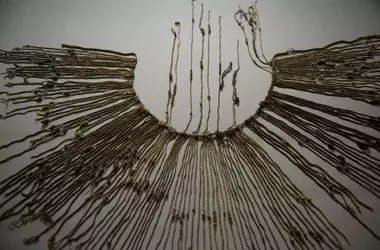 Aug 13, 2025
Unraveling Inca Mysteries: Human Hair in Khipu Suggests Widespread Literacy
A groundbreaking analysis of a khipu, an ancient Incan knotted-cord record-keeping system, reveals the unexpected presence of human hair. This discovery challenges the long-held belief that khipus were exclusively the domain of the elite, suggesting that commoners might also have participated in this intricate form of record-keeping. The findings, based on dietary analysis from the hair strands, could revolutionize our understanding of literacy and societal structure in the Inca Empire, pushing for a re-evaluation of numerous unexamined khipus in museum collections.
By Carl Bernstein