Art Training
The Mechanics of Self-Directed Visual Education: Art Training Without Formal Classes

Art Training Without Formal Classes is a self-regulated pedagogical approach where a learner acquires visual art competencies through independent study, decentralized resources, and deliberate practice rather than a curriculum-led institutional environment. This method relies on the "autodidactic" model of learning, necessitating high levels of metacognitive awareness—the ability to self-diagnose technical weaknesses and prescribe corrective exercises. In a landscape where information is increasingly digitized, the effectiveness of this approach is determined by the learner's ability to simulate the rigorous feedback loops typically provided by an instructor.
This article provides an objective overview of the technical requirements and structural frameworks for self-directed art training. It will analyze the foundational concepts of visual literacy, explain the core mechanisms of skill acquisition outside a classroom, and discuss the objective landscape of self-study versus institutional education. The discussion concludes with a summary of emerging technological developments and a clarifying question-and-answer section.
I. Defining Objectives: Establishing a Technical Baseline
The primary objective of self-directed training is the systematic development of Observational Accuracy and Technical Proficiency. Without a formal syllabus, the learner must establish objective benchmarks to ensure growth. These objectives typically involve:
- The Shift from Symbols to Forms: Moving away from "symbolic drawing" (relying on mental icons) to "perceptual drawing" (recording light and geometry).
- Motor Skill Refinement: Developing the hand-eye coordination required for precise line weight and pressure control.
- Theoretical Integration: Mastering the physics of light, the mathematics of perspective, and the chemistry of color mixing.
II. Foundational Concepts: The Elements of Visual Literacy
For a learner practicing without an instructor, it is essential to categorize the "Elements of Art" into a logical hierarchy of study.
1. Primitive Solids and Construction
Visual deconstruction is the process of breaking down complex objects into "primitive solids"—the sphere, cube, cylinder, and cone. These forms are the building blocks of 3D construction on a 2D surface.
2. Value Scales and Light Logic
Value refers to the relative lightness or darkness of a surface. Self-study requires a technical understanding of the "Value Scale" and the behavior of light as it hits a form, creating specific zones such as the highlight, mid-tone, core shadow, and reflected light.
3. Linear Perspective
Perspective is the mathematical framework for representing three-dimensional space. Understanding the Horizon Line and Vanishing Points is the mechanical requirement for creating a convincing sense of depth.
III. Core Mechanisms: Feedback Loops and Deliberate Practice
The mechanism that distinguishes effective self-training from casual practice is Deliberate Practice. This involves a cycle of performance, objective assessment, and focused correction.
1. The 70-20-10 Developmental Model
This framework, widely used in professional skill acquisition, can be adapted for art training outside formal classes:
- 70% Experiential: Active drawing and application of concepts through repetition.
- 20% Social: Engaging in peer critiques or master studies (analyzing the technical process of established artists).
- 10% Formal: Using textbooks or structured digital tutorials to learn foundational theory.
2. Self-Correction via Overlay Analysis
A critical mechanism for the self-taught artist is the "Overlay Feedback Loop." This involves drawing from a reference, then physically or digitally overlaying the reference on top of the drawing to identify exact discrepancies in proportion and angle. This objective data prevents the reinforcement of incorrect motor habits.
3. Spaced Repetition and Cognitive Consolidation
Neuroplasticity—the brain’s ability to form new neural pathways—requires Spaced Repetition. Practicing a specific fundamental (e.g., ellipses) in short, frequent intervals is more effective for "procedural memory" than infrequent, long-duration sessions.
IV. Presenting the Complete Landscape: Objective Discussion
Self-directed art training occurs within a broader educational context that offers both specific advantages and significant technical challenges.
1. Information Density vs. Quality Control
The modern era provides an unprecedented volume of information. According to data from the UNESCO Open Educational Resources (OER) initiative, decentralized learning materials have expanded significantly, allowing for high-level technical study globally (). However, a primary challenge for the self-directed learner is the lack of "curatorial oversight," which can lead to consuming information without practical application.
2. The Stages of Competence
Independent learners must navigate the Stages of Competence without external guidance. The transition from "Conscious Incompetence" (knowing you have an error but unable to fix it) to "Conscious Competence" is the most common point of stagnation in self-directed training.
3. Traditional vs. Digital Media
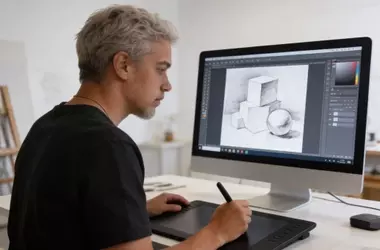
While the fundamentals remain the same, media choice affects the training routine. Traditional media (charcoal, pencil) offers higher tactile feedback, while digital media (tablets, software) allows for faster "iteration loops" due to non-destructive editing (undo/layers).
V. Summary and Outlook: The Shift Toward Hybrid Autodidacticism
The trajectory of art training is moving toward a model where formal degrees are often secondary to Portfolio-Based Evidence.
- Algorithmic Assistance: Future self-directed training may involve software diagnostics that can analyze a digital brushstroke to provide feedback on line confidence or value distribution.
- Skills-First Hiring: In sectors like concept art and game design, "competency-based evidence" is increasingly the standard for professional validation over institutional credentials.
- Community-Led Curricula: Decentralized communities are creating open-source "syllabi" that mimic the rigor of traditional Ateliers, providing a roadmap for independent learners.
VI. Question and Answer (Q&A)
Q: Is "talent" required to succeed in art training without formal classes?
A: From a technical perspective, art is a set of learned motor skills and cognitive frameworks. Research in neuroplasticity suggests that the ability to render accurately is the result of systematic observational habits, and these habits can be built through deliberate practice.
Q: How much time should a self-directed learner spend on fundamentals?
A: A common objective framework is the 50/50 Rule. This suggests spending 50% of practice time on structured fundamentals (perspective, anatomy) and 50% on personal projects to maintain motivation and apply learned concepts.
Q: Can a self-taught artist achieve the same level of proficiency as a class-taught artist?
A: Yes. Historically, many artists have achieved high levels of proficiency through apprenticeship or self-study. The primary variable is the "Feedback Frequency"—as long as the independent learner finds objective ways to critique their work, the technical outcome can be identical to institutional training.
Q: What is the most common reason for failure in self-directed training?
A: The most common obstacle is the "Knowledge-Action Gap." This occurs when a learner studies the theory of art (e.g., reading an anatomy book) but fails to perform the physical repetition required to encode that knowledge into motor memory.

Russian language tutor and cultural guide, offering deep dives into Slavic linguistics and literature.
Exploration ArchivesOther Articles
 Dec 30, 2025
The Mechanics of Habituation: How to Build Consistency in Art Training
Art Training Skill Progressionrefers to the structured trajectory through which a learner acquires, integrates, and masters visual art competencies. For the hobbyist, this process is characterized by a transition from symbolic representation—drawing based on internalized icons—to perceptual representation, which relies on the physics of light, geometry, and spatial logic. Progression is non-linear and is governed by the accumulation of specific mental models and motor refinements.
 By Youssef Khoury
 Dec 30, 2025
Art Training for All Ages: A Comprehensive Beginner’s Guide
Art Trainingis the systematic process of acquiring visual literacy, motor control, and theoretical knowledge to represent or interpret the physical and conceptual world through various media. Regardless of the learner's age, this process involves the transition from symbolic representation to a technical understanding of how light, form, and perspective interact. This guide provides a neutral, information-based analysis of the core components required for foundational art education.
 By Talia Salt
 Dec 30, 2025
The Mechanics of Visual Development: Systematic Creative Art Training Practice Methods
Art Training Skill Progressionrefers to the structured trajectory through which a non-professional learner acquires, integrates, and masters visual art competencies. For the hobbyist, this process is characterized by a transition from symbolic representation—drawing based on internalized icons—to perceptual representation, which relies on the physics of light, geometry, and spatial logic. Progression is non-linear and is governed by the accumulation of specific mental models and motor refinements.
By Talia Salt