

Understanding Patient Monitors: Principles, Functions, and Clinical Contexts
1. Objective Definition
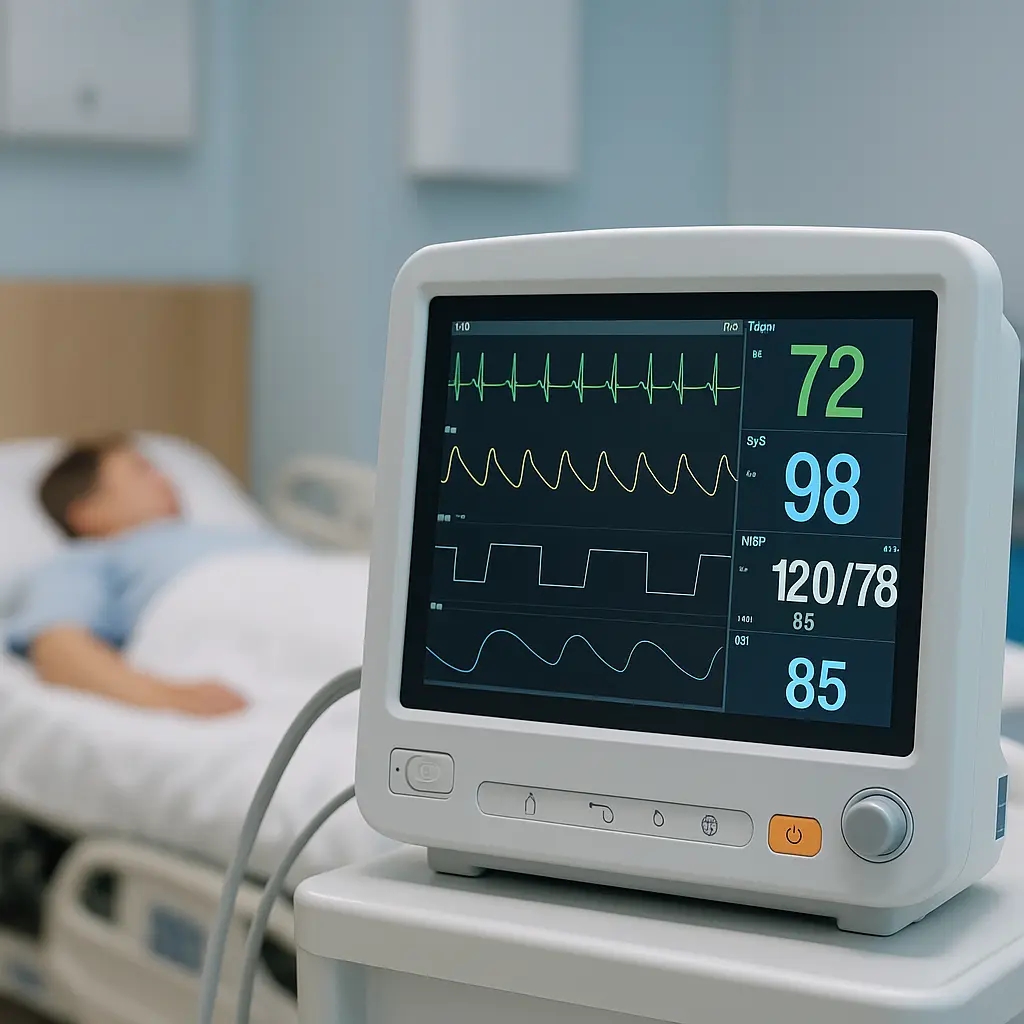
A patient monitor, often referred to as a bedside or vital signs monitor, is a system that collects, processes, and displays real-time physiological data from an individual. These devices are widely used in hospitals, clinics, and sometimes home-care environments to observe changes in health status.
The purpose of this article is to clarify what patient monitors are, how they function, and in which contexts they are used. It also aims to explain the mechanisms behind the measurements, discuss their clinical value and limitations, and provide a balanced overview without making evaluative or promotional claims.
2. Basic Concept Analysis
Patient monitors are composed of sensors, processing units, and display interfaces. Sensors are attached to the body to collect physiological signals. These signals are then converted into electrical data, processed through algorithms, and presented visually or audibly.
Common parameters measured include:
- Electrocardiogram (ECG) for heart activity
- Blood pressure (non-invasive or invasive)
- Oxygen saturation (SpO₂) using pulse oximetry
- Respiratory rate
- Body temperature
Monitoring can be continuous or intermittent. Continuous monitoring is typical in intensive care units, while intermittent monitoring is more common in outpatient or general ward settings.
Patient monitors can be classified into several categories:
- Bedside monitors: used in hospital environments
- Portable monitors: used during transport or in emergency care
- Wearable monitors: designed for ambulatory or home use
3. Core Mechanisms and In-Depth Explanation
Signal Acquisition
Each physiological parameter requires a specific sensing technology. For example:
- ECG uses electrodes placed on the skin to detect electrical activity of the heart.
- Pulse oximetry uses light absorption at different wavelengths to estimate oxygen saturation.
- Blood pressure monitors may use oscillometric methods to detect arterial wall motion.
Signal Processing
Raw signals collected from the body are often subject to noise and interference. Signal processing algorithms filter and refine the data to produce reliable readings. For instance, motion artifacts in pulse oximetry are reduced using adaptive filtering techniques.
Data Integration and Display
Modern monitors integrate multiple data streams into a single interface. Waveforms, numerical values, and alarm systems are presented simultaneously. Alarms are triggered when parameters exceed predefined thresholds.
Connectivity and Data Storage
Many monitors are integrated with hospital information systems. Data can be stored, analyzed over time, and accessed remotely. This supports longitudinal observation and clinical decision-making.
4. Comprehensive Overview and Objective Discussion
Clinical Applications
Patient monitors are used in various settings:
- Intensive care units for critically ill individuals
- Operating rooms for anesthesia monitoring
- Emergency departments for acute assessment
- General wards for routine observation
Continuous monitoring has been associated with earlier detection of physiological deterioration in some clinical contexts. According to research published by the National Institutes of Health, early warning systems based on monitored data can support timely interventions.
Benefits
- Real-time data availability
- Early detection of abnormal trends
- Support for clinical decision-making
- Integration with electronic health records
Limitations
- False alarms are common, which may contribute to alarm fatigue
- Accuracy can be affected by motion, poor sensor placement, or environmental factors
- Over-reliance on monitored data may reduce emphasis on clinical examination
- Data interpretation requires trained personnel
Ethical and Operational Considerations
The use of monitoring devices raises questions about data privacy, patient autonomy, and resource allocation. In some settings, continuous monitoring may not be necessary and could lead to unnecessary interventions.
5. Summary and Outlook
Patient monitors play a central role in modern healthcare by providing continuous insight into physiological status. Their functionality relies on a combination of sensor technology, signal processing, and data integration.
Future developments are expected to focus on:
- Improved accuracy and reduction of false alarms
- Integration with artificial intelligence for predictive analytics
- Expansion of wearable monitoring technologies
- Enhanced interoperability between systems
These developments may contribute to more personalized and data-driven healthcare, although their impact depends on appropriate implementation and interpretation.
6. Q&A Section
Q1: Are patient monitors always accurate?
Accuracy depends on proper sensor placement, device calibration, and patient conditions. External factors such as movement or poor circulation can affect readings.
Q2: Do all patients require continuous monitoring?
Continuous monitoring is typically reserved for individuals with unstable or critical conditions. In other cases, periodic measurement may be sufficient.
Q3: What causes false alarms?
False alarms may result from sensor displacement, motion artifacts, or technical limitations in signal processing.
Q4: Can patient monitors replace clinical judgment?
Patient monitors provide supportive data but do not replace clinical evaluation. Interpretation requires context and professional expertise.
Q5: How is patient data from monitors used?
Data may be stored, reviewed over time, and integrated into broader clinical records to support diagnosis and treatment decisions.
References (Links Only)
- https://www.ncbi.nlm.nih.gov/books/NBK553178/
- https://www.who.int/publications/i/item/9789241508035
- https://www.fda.gov/medical-devices/general-hospital-devices-and-supplies/patient-monitors
- https://www.ncbi.nlm.nih.gov/pmc/articles/PMC7082742/
- https://www.ahajournals.org/doi/10.1161/CIR.0000000000001025
Related Articles
Vaccination Clinics in Malaysia: A Practical Guide to Immunisation
Mar 9, 2026 at 7:10 AM
Understanding IVF Assistance: A Guide to Navigating Your Options
Feb 11, 2026 at 5:29 AM
Your Guide to Sleep Medicine: A Realistic Look at Seeing a Sleep Doctor in the U.S.
Mar 4, 2026 at 3:41 AM
Ways to Promote Hair Growth - Both Men and Women Should Learn
Apr 7, 2026 at 8:53 AM
Revitalize Your Skin: The Ultimate Guide to Laser Skin Resurfacing
Jul 3, 2025 at 3:38 AM
A Guide to Atrial Fibrillation Treatment: Management Strategies and New Options
Apr 13, 2026 at 6:59 AM
Exercise Health Assessment: Evaluation Methods, Physiological Indicators
Apr 10, 2026 at 9:26 AM
Chronic Disease Management Guidance: Frameworks, Behavioral Principles
Apr 10, 2026 at 9:22 AM
Chronic Obstructive Pulmonary Disease: Definition, Mechanisms, and Clinical Understanding
Apr 15, 2026 at 9:27 AM
Ultrasound Imaging Systems: Principles, Technology, and Clinical Context
Apr 9, 2026 at 9:29 AM
Nutritional Counseling: Definition, Mechanisms, and Practice Framework
Apr 15, 2026 at 9:33 AM
Anti-Aging Care: Biological Mechanisms, Interventions, and Scientific Perspectives
Apr 7, 2026 at 8:58 AM
Infusion Pump: Mechanisms, Clinical Applications, and Technological Overview
Apr 8, 2026 at 9:48 AM
Photorejuvenation: Principles, Mechanisms, and Clinical Interpretation
Apr 10, 2026 at 9:29 AM
Psychological Counseling: Concepts, Mechanisms, and Practice Context
Apr 15, 2026 at 9:30 AM
Understanding Blood Pressure Monitors: Principles, Accuracy, and Role in Health Assessment
Apr 10, 2026 at 9:18 AM
Dietary Guidance for Diabetes: Nutritional Principles, Metabolic Mechanisms, and Practical Context
Apr 9, 2026 at 9:41 AM
Couples Counseling: Concepts, Processes, and Psychological Frameworks
Apr 7, 2026 at 8:54 AM
Blood Glucose Monitors: Principles, Measurement Methods, and Clinical Context
Apr 9, 2026 at 9:27 AM
Nutrition Consultation and Counseling
Apr 13, 2026 at 9:24 AM


This website only serves as an information collection platform and does not provide related services. All content provided on the website comes from third-party public sources.Always seek the advice of a qualified professional in relation to any specific problem or issue. The information provided on this site is provided "as it is" without warranty of any kind, either express or implied, including but not limited to the implied warranties of merchantability, fitness for a particular purpose, or non-infringement. The owners and operators of this site are not liable for any damages whatsoever arising out of or in connection with the use of this site or the information contained herein.